Monday, May 4, 2009

Woman Warrior

After finishing Kingston’s novel, I realize that I have never come to grips with the fact that I have been fortunate not to have faced the difficulties of immigration, among other things. I noticed a lot of similarities between Kingston and me, but I had to put everything in the perspective that she was growing up facing a culture that was foreign to her and her family, while I was born an assimilated member. The most striking of these was of Kingston’s reticence in class and to people in general, “A dumbness—a shame—still cracks my voice in two, even when I want to say ‘hello.’” (165) I know exactly what she is talking about—that cracking “dumbness”—when I try to squeak out a greeting or question in what I manufacture to be an anxious situation. As if one cue with my life, she notes that “A telephone call makes my throat bleed and takes up that day’s courage.” (165) I can’t begin to explain how much I despised making telephone calls to strangers when I was younger. But Kingston literally hit the nail on the head and described my anxiety regarding telecommunication perfectly.

It’s like we’re the same person![1]

The difference, however, is that Kingston’s shyness and anxiety is compounded by the fact that she grew up not knowing her culture and feeling foreign to those around her. I did not. Facing this reality puts my own struggle with communication in perspective. I did not have to try to be anything; I was already normal. Further, in her anecdote about how her mother forced her to ask the drugstore clerks to give her candy, Kingston says that her mother “thought she had the Druggist Ghosts a lesson in good manners.” (171) Once again, the awkward way in which she described herself doing this made me realize how difficult it would have been for me to be placed into a foreign setting: I am shy enough already. I would never be able to face the type of discrimination that immigrants did. Making Kingston’s plight even more apparent was her enjoyment of her extended bedstay when she got sick. “It was the best year and a half of my life. Nothing happened.” (182) Ask any of my friends and they will tell you how much I love doing absolutely nothing but hang around, sleep, eat, and watch tv. It is perhaps my favorite past time. But I do this to escape (far more than necessary, however) the hectic reality of being a student. Kingston did it because she didn’t have to face the difficulties of life in the United States.

I guess I realized that I was born and stayed in place that I could always call home. Kingston and other Asian immigrants did not have this luxury, stating that they felt they “don’t belong anywhere” (184) when facing the threat of deportation, feeling that they were being tricked by immigration services to turn themselves in. That statement reminded me very much of my freshman experience as a whole, now coming to close and leaving me in doubt more than ever of where it is that I belong. Also, it reminded me of a particular scene in Garden State.

Check 1:25 into this trailer.
http://www.youtube.com/watch?v=u82n0e1mgmQ

Feeling lost himself, Zach Braff says “You know that point in your life when you realize the house you grew up in isn’t really your home anymore? That idea of home is gone.” (Garden State) For once, I do feel, however microcosmically, that I am in libmo, a place of now home. But unlike the immigrants Kingston shows us, I don’t have to try to be something I am not. Moon Orchid’s estranged husband says that he can’t take her back because he is “living like an American.” (153) I will thank my stars that I have only had to transition from Dallasite to Austinite, from high schooler to college kid, and not Chinese to American.

[1]http://daniel9012.files.wordpress.com/2008/11/talkingstory.gif

Wednesday, March 25, 2009

The Child Inside

The summer of 1996 was perhaps the most influential season of my life. It was that June that I became aware of the game of baseball when, for my friend’s 6th birthday, I sat on the first row behind the dugout of a Texas Rangers baseball game. As if knowing that I was a potential devotee to the sport, the home team recorded a then franchise record twenty something runs, and first basemen Will Clark emerged as my first hero after smashing what I remember being a 1,000,000 foot homerun into the second deck above right field. A boyish captivation with the majesty of baseball emerged on that night, later blossoming into the most defining attribute of my growing up.

The Rangers treated me nicely that summer, winning the American League West, and earning their first playoff berth in franchise history. On October 1, 1996, they squared off against the New York Yankees in their first ever postseason game. I remember exactly what happened in that game—where I was sitting, what I was eating, and looking back on it, how the events that took place on that night would cast a mold over the rest of my childhood. Watching the game with my brother and dad, the game started slowly when Juan Gonzalez sent a ball approximately six inches inside the left field foul-poll and two feet over the fence in the top of the fourth inning. Controversially deemed a homerun, my otherwise stoic father exploded out of his chair, drunk off the mirth of a hometown success, leaped and cackled about the room, and shouted, “Juan Gonzalez just hit a homerun in the playoffs!” Apparently unfazed by the excitement, I shot my father with a murderous glare in silent disapproval of his enthusiasm for the occurrence, instantaneously decapitating the boy who lived inside him, who crazed over the game of baseball. With just that look of disinterest from his sons, his zeal faded away.

Though my father would teach me everything he knew about the game that he loved, I never again saw such ecstasy in him because a sage stoicism had set in. Little did I know that against the warm background of that October sky, I had committed the most heinous of subtle crimes against my father—shunning the little boy inside him and killing a part of his personality. The memory of that night has been with me since it happened, but it was not until I got to college that I recognized the importance of its lessons. Coddled in a middle and high school environment where boys were free to be boys, I did not realize the significance of the whimsically playful and sensitive spirit natural to me because I had nothing else to compare it to, no parameters or boundaries, and I never had to put on the mask that every boy wears in front of a girl. But after coming to UT and to Plan II especially (seeing as how it is over 60% female), immediate and necessary adaptations were made, and I now realize how boyish I am and why I choose to be so. Sometimes immature, sometimes sensitive, but often energetic, always playful, and always looking for a ball and a person to play catch.

Perhaps the most striking change in college that has made me realize more about my nature is that a smaller percentage of people in the honors quad care about sports compared to my experience in high school. I have found myself itching for someone to talk with about the Stars’ playoff chances, craving a group of guys to play football with, and needing ten other players to form a soccer team. I have supplemented my free afternoons with games of ball and other general, boyish shenanigans. More times than not, every Tuesday and Thursday afternoon between the hours of 2 and 3:30, I can be found jumping around the quad, trying nothing more than to see how high I can get, or if I can clear the bushes by the Andrews steps. Something about the feeling of physical activity, of tossing a ball back and forth, of the wind in my face as I sprint, of my acceleration towards Earth after jumping from a step—something about all of these actions mindlessly and inexplicably make me happy.

But, alas, there is more to life, and more to me, than the capricious levity that I have described. Despite my passion for individualism, I realize that there is a time and place, and the child inside of me can only exist in certain situations. The hardest part of my college experience has been to quiet the calling of the boy inside, beckoning me to let him out and play. Society and academia have little room for 19-year-old boys. Particularly in the area of relationships have I had to send the child back to his room, into the labyrinth of my heart, in order to be mature enough to handle the problems that old teenagers create. But simultaneously, the boy has allowed me to view the world from the unscathed lens of innocence. Others have found his sensitivity and unselfishness endearing, and when I let him out, I have been able to forge some of the strongest friendships that I have ever had.

Academically, the boy inside affects me in the same way. At times, I find it almost impossible to work—children indeed have the worst time management. Midterms, papers, and exams are the bane of the child that sends him scurrying back to his room when there is no time to play. But as with relationships, the boy lets me be free. Recently, I have realized my love of the liberal arts and my distaste for the surgical exactitude of certain classes that leave a calculated, electric taste, like that of a battery. There is an ambience of hazard about the liberal arts that encourages the foolhardy, inquisitive mind to explore the depths of the human condition. Only with a delighted ignorance can a mind stomach the dark, depraved findings on the nature of man, and only with the gaudy dreams of a child can one hope to supplant this melancholy with a resolution greater than himself.

So it is because of the boy that I revel in the intellectual freedom of the liberal arts. I have even begun to question anyone’s desire to study any subject outside the liberal arts, without the intent of supplementation. Pure science majors confound me. And even more—business majors! Fittingly, was I to ask such students what their motivation is, I think I would find several answers centered around the word “career.” What does a boy care about a career? He doesn’t. And thus, I have arrived at the biggest change I have undergone since I came to UT. For a time in high school—a long time—I was professionally motivated. Hard work led to good grades which led to a better college which led to a better career potential. It is the simple path that many young people are influenced by. The strange thing is, then, that even in that cookie-cutter life plan, nuggets of truth can be found. I think that is why I do not look down on myself for once viewing education and even my life like that. Though it may sound contradictory, I do not look down on people who are still motivated by that; I am merely stumped because for the first time in my life, I really think I have figured something out. If not about life in general, I have learned it about myself. I no longer find that as motivation because it is too one-dimensional. It helped me get good grades in high school. It also helped me last semester. But it only helped with grades. Recently, and I mean very recently, I have realized that this is no longer all that I want. Our readings about ahimsa, Buddhism, and Jainism have led to me to put together everything we have talked about all year. And, as if in an epiphany that has been gradually occurring since I was born, I realize that I want to become a better person: I want to become something greater than myself. Those are vaguely worded goals because I have no idea what they mean exactly—I don’t think anyone does. For once, the OED is no help. I have lived so long only satisfying myself with the pride I could derive from working hard, making good grades, and other assorted achievements. But I realize now that all of those years I was missing something, and landing a six-figure job straight out of undergrad isn’t going to fill the void. And it is not that I ever thought that a career and money alone would solve my problems. But until now, I have never faced the reality that landing that job was all I could hope for, unless I found a new paradigm. Perhaps a greater form of compassion or some Western ahimsa is what I am trying to create—I don’t know. But only a child could dream such possibilities.

Wednesday, March 11, 2009

The Idiot Performance Reponse

My initial reaction to The Idiot was that I found myself analyzing the play in the same way that I analyze books for any literature class. I was entirely drawn in by the play, but because the matter of the story was so dense and introspective, I found it hard to focus on the performance itself, aside from the storyline and messages that it was trying to convey. In that sense, I found that the play did indeed reach me. Having read Dostoevsky before (although not this particular selection), I found myself relating once again to the bitter melancholy that flavors most of his pieces. The topics of the depravity of mankind, atheism, nihilism and religion, and social movement are all riveting discussions among themselves in an English class, but while stimulating, they are mind-drudgingly heavy, and ones that I try to reserve to English class alone. On that note, I found the play a little boring. I admit I was drawn in, but on a Saturday night, I am usually in the mood for something fun and intellectually shallow, whereas in this situation I was placed into the opposite.
Regardless, the show left me with emotions of melancholy and bitterness, like all great works of literature do. Perhaps the most striking difference between reading about this topics was seeing them acted out before my eyes. This was the most rewarding part of this performance from my perspective. Rather than forging the “as if” in my brain, I could see how the often futile nature of life affected the individual characters, and my mind was able to think about other things, not having to create an image for myself. The most stirring of these images were the expressions on Myshkin’s face. He represented the good man struggling through the tides of depravity and forlornness that affect that vast reaches of mankind. His face was constantly fighting back a childish smile, but when he faced the decisions that grew out of his multiple loves, the hard and cold nature of life was particularly evident in his crushed and defeated smile, yearning for a life in which all could be as good as he.
On that same note, I think the actor that played Myshkin stood out above the rest. In the beginning of the play, it seemed like he was forcing some sort of foolish ignorance of the world and its ways, but by the end of the play I realized that that is exactly what he was trying to convey: a confused, helpless, sick man trying to make good out of a stirring situation. After him, I think the actress that played Nastasya Filippovna stood out as the 2nd best in the show to me. The way she conveyed her character as a woman trying to make something better out of a life she knew she had lost any semblance of goodness.
I don’t know that I would recommend this play to my friend’s if they were looking for something to be entertained by. However, I would recommend this to someone in a dark, introspective mood, searching for higher answers. Disjointly, if there was one “problem” I had with the play, it was that it was very hard to keep track of the very Russian names, and so I found myself often confused by who was who.

Western, Social Ahimsa

Over the winter break, I found myself making a pledge to “not do mean things” to other people anymore. This promise to myself was based on the realization that almost all of the non-academic problems I dealt with in the first semester would have been almost entirely prevented had I made, for lack of a better word, nicer decisions.

Perhaps this nugget of kindergarten indeed transcends the age at which it is learned.[1]

Upon reading the second part of Siddhartha and the article on Ahimsa, I have realized that in order to achieve this “niceness” I have to learn the sense of spirituality that guides the novel’s protagnist, and all Buddhists and Jains in general. In describing the fundamental practice behind ahimsa, the article reads, “In the regeneration and divinization of man, the first step is to eliminate his beastly nature. The predominant trait in beasts is cruelty” (X224). Reading this, I realized that my desires to belittle, poke fun at, or chastise others are forms of cruelty, however righteous I might view them to be, and at that, are beastly. Taking this farther, it is true that “Man attains peace by injuring no living creature. There is one religion – the religion of love, of peace” (X224). This statement speaks to the universal spirituality that exists in all man. With or without faith or religion, by doing good or nice things, we feel better about ourselves—we are at peace.

However cliche, being at peace with oneself is one of the few attainable ideals in life.[2]

Reading the article further, I began to realize that Ahimsa is something I should strive for. No, this is not my vegetarian coming out party, but there are innumerable opportunities that I miss out on when it comes to practicing non-injury to other humans. The idea is not even far-fetched. Moreover, it is simply an extension of the pledge I made over the break, “It is extremely difficult to control such thoughts from the very beginning without having recourse to control of the body and speech first” (X226). But once the immediate urges of the body are contained, ahimsa can seep through the soul, and I can achieve my goal.

This section of Siddhartha parallels this topic perfectly. Unlike the first section in which Siddhartha seemed to be disconnected himself from the world around him, we now see the compassionate side of him. In fact, once being around Kamala and noticing the power of love, “He was happy, for he felt the need to be among people” (Hesse 50). His desire to feel love shows through in his quest to please Kamala, whom he goes out of his way to please, practicing only fasting, waiting, and thinking. Upon returning from the tasks which Kamala sent him out to do, Siddhartha comments that, “Most people, Kamala, are like a falling leaf that is blown and is turning around through the air, wavering and tumbling to the ground. But others, a few, are like stars: they go on a fixed course, no wind reaches them, and in themselves they have their law and their direction” (Hesse 70). I found this to be particularly applicaple to my promise to myself. Despite having made this pledge, I have found my mind taking advantage of my body and indeed injuring those around me. I am that falling leaf, and in order to practice some form of ahimsa I must become the star, applying the law of non-injury to at least the social part of my life.
I can take Siddhartha’s written words to Kamaswami to heart: “Writing is good, thinking is better. Intelligence is good, but patience is better” (Hesse 63).

Look before you leap: an aphorism for the wise, even Siddhartha.[3]

The article on ahimsa eventually discusses that the virtue as an ideal is unattainable, that “You have to destroy life in order to live” (X227). But as with all religions, compromises are to be made to support the human condition (after all, Jesus did die for us). Even in describing the life of a merchant, “Everyone takes, everyone gives, such is life” (Hesse 62).

Perhaps once my form of western-social-ahimsa succeeds, my problems will lessen, and I will be happier. And one step closer to Nirvana.

[1]http://z.about.com/d/crossstitch/1/7/7/Q/-/-/golden-rule.jpg
[2]http://www.thewip.net/contributors/peace-sign.jpg
[3]http://www.wordsellinc.com/wp-content/uploads/word-sell-cliff-diver.jpg

Monday, March 9, 2009

Buddhism

I do not relate to Eastern religion. That is it.

In the description of how Govinda Idolized Siddhartha, Hesse writes about how selfless and pleasing Siddhartha was to all those around him. He concludes, however, that Siddhartha didn’t bring himself joy; he didn’t please himself” (Hesse 7). Buddhism seems to seek a different form of asceticism than the Jains. Rather than practicing ahimsa out of compassion, Buddhists seek complete disconnection with the world, in a completely opposite manner, based on the self alone. Ironically, Govinda, though deferential to Siddhartha, points out this void of compassion when he realizes that Siddhartha has indeed left him, “’Siddartha!’ he exclaimed in a lamenting voice” (Hesse 32). One of his closest followers “laments” Siddhartha’s departure because achieving Nirvana is a singular act, perhaps a selfish one. But this could be recognition of the futility of life otherwise—an faith rooted in the same convolutions as western religions, but more extreme in its means and ends. When his father confronts Siddhartha about his perpetual meditation, he states “You will die, Siddhartha.” To which he replies, “I will die” (Hesse 13). I think Siddhartha’s blunt concession in his retort is perhaps the fundamental reason behind his somewhat peculiar goals. I suppose that I find them peculiar because, in all of life’s futility, why would I want to sever my connection with the one aspect of humanity that keeps me sane: companionship (or, more specifically, love). But once again, I find the answer in the father’s compliance, “If you have found blessedness in the woods, then come and teach me how to be blessed. If you find disappointment, then return once more and let us once again sacrifice to the gods together” (Hesse 14). Siddhartha’s choice is obvious, and it is one mystery that must be chalked up to the perplexing intricacies of the human heart and where it may lead its host, hence my choosing of this song.


Listen To Your Heart (Techno) - DHT


In his pursuing the cessation of existence with the tangible world, Siddhartha garners many questions from Govinda about how it might be possible or even desirable. His explanation is such, “It is flight from one’s being, it’s a brief escape out of the agony of self-existence, it’s a momentary anesthetic against the pain and meaninglessness of life” (Hesse 19). I find this obsession with disconnectivity entirely strange, but even among people of his culture, Siddhartha had different goals, “I don’t have any desire to walk on water. Let the old Samanas satisfy themselves with such trucks” (Hesse 26). Once Govinda and Siddhartha come upon the Buddha praying, they note that “His calm face was neither happy nor sad, it seemed to smile quietly and inwardly” (Hesse 29). The Buddha is described almost to have achieved a state of ignorance of the world around him, its futility and existence. I question my notion that which the Buddhist seeks is a state of blissful ignorance, but further in the text, I find no answer. In a revealing conversation with the Buddha, Siddhartha asks the revered one about his one uncertainty with his teachings: the disconnection of the ultimate goal from all life. Siddhartha exclaims, “But there is one thing which these lucid and honorable teachings do not contain: they do not contain the mystery of what the exalted one alone among hundreds of thousands has experienced for himself” (Heese 35). I find it empty, almost, that no explanation is available for the state of nirvana. I do believe that it is achievable for the most devout, but to what end? To a severance with the rest of the world. From my western perspective, that does not seem desirable.

There is something beautiful in the sense of companionship--something I do not want to relinquish. [1]

In “The Light of Asia” we see a different side to Buddhism than in the first part of Hesse’s novel. In this article, the sense of mercy and compassion of the Buddha is discussed, whereas it seems almost nonexistent in Hesse. However, the motivation behind Siddhartha’s goals in Hesse becomes more evident in this piece. After a long list describing the beauty of life, Arnold writes that “All things spoke peace and plenty, and the Prince saw and rejoiced. But, looking deep, he saw the thorns which grow upon this rose of life: How the swart peasant sweated for his wage, toiling for leave to live; and how he urged the great-eyed oxen through the flaming hours, goading their velvet flanks” (X241). In this case, the Buddha observes nothing but the toilsome cycle of punishment and agony that one being inflicts upon another, and his goals are better explained. But even then, to singularly displace oneself from the rest of the world, to achieve a state of Nirvana—these both seem far too extreme for me. There is little splendor in the imperfection of the cycle of mankind’s relationship to himself and to nature, but there is a well of joy to be gained from compassion, sympathy, love, and affection.

[1]https://blogger.googleusercontent.com/img/b/R29vZ2xl/AVvXsEiL4kzzKTWEh8V-AOflWs5XTKI1hp6dpOHrbyk8DtnAVqSzBqbmHJpmlCjjoC2gI9nJ9Y6tyxqAkzBV6iacuscsHfvQNmex1h_EfGWsaFfqHpTkBLk3OakMGMC0rArlYX7ltxCGGocir1Q/s400/Companionship.bmp

Wednesday, March 4, 2009

East versus West

Perhaps the most telling example of difference between Western and Eastern thought on the subject of animal rights is given by Kipling. He describes an instance of the “Oriental tender mercy” in which a man feeds a tiger pieces of his own flesh. Kipling writes, “This may be heroic, but like many other illustrious examples of Oriental goodness, it is also absurd, and so remote from every possibility of ordinary life and conduct as to exert no practical influence as a lesson.” (X251)

The gap between east and west extends to all aspects of life. [1]

The choice of the word “absurd” is interesting considering how that is the absolute standard for many in Asia. This difference is derived from the fact that Western religions worship an intangible deity, whereas eastern faiths like Jainism and Hinduism look to animals to find symbols of power and beauty. In “Jainism and Ecology, we see a description of the Jainist mindset and how their practice of ahimsa (defined as absolute nonviolence) has a direct relation to their reverence for animals. Perhaps the most famous person to practice nonviolence is Mahatma Gandhi, “who combined love and nonviolence”(X231). Gandhi describes the virtue of ahimsa as a “means” and continues to say “In its positive form, ahimsa means the largest love, greatest charity”(X231). I must disagree with Gandhi. The keyword, here, however, is “positive” ahimsa. Simply, ahimsa for the sake of ahimsa is not love—it is a practice of nonviolence and nothing more. I would correct him to say that love (and compassion) for animals is the means and ahimsa follows as the end. From West to East, I think the lack of love because of different symbols of reverence accounts for Kipling referring to Oriental practices as “absurd.”

I understand better now our practice of "love channeling." It is the basis of all compassion.[2]

The article then begins to discuss the cause of the ecological crisis from a Jainist perspective as a lack of spirituality and perpetuation of greed. Lily de Silva said, “We have to understand that pollution in the environment has been caused because there has been psychological pollution within ourselves” (X232). The “psychological pollution within ourselves” is the same as the absence of Love and reverence for animals in western thought. At some point, concern for the environment, for animals, and for all living things must come from the heart. From a western perspective, however, deeming this “pollution” seems somewhat condescending. In discussing the apparent idealism and hints of absurdity that taints Jainism from a western eye, the article discusses a situation when a disciple raises a concern about the natural tendency of human survival to cause suffering on some living things. Lord Mahavira’s response is simply, “If you are aware of all of your actions, and are careful about what you do in relation to other living things, you will develop spirituality and be in perfect harmony with the natural world” (X234). How is this at all a valid response to the disciple’s statement? It seems like a shirking of reality, revealing the unattainable idealism inherent in Jainism. While I respect the practice, Kipling hits the nail on the head: it is almost absurd to expect a wide range of humans to practice such ahimsa. Upon researching, as per Wikipedia, less than 1% of the Indian population (let alone the world’s) is Jain.

In the article “Man, Culture and Animals in India,” the institutions of the pinjrapole and goshala are described as places of sanctuary, so to speak, for cows. According to the article, the words “ahimsa paramo dharma” are written above the gateways to all pinjrapoles. Translating to “ahimsa is the greatest of religions,” according to the article, “In this aphorism is summed up the entire raison d’etre of pinjrapoles, for it is the extension of ahimsa and the related concept of jiv-daya (compassion for life) to embrace all animal life that accounts for the presence of the institutions in Inida today” (X266). Just like in Gandhi’s words, the virtue of ahimsa can only exist with a certain love or compassion that must inherent in one’s heart. Otherwise, ahimsa exists for ahimsa alone, futilely, as I said before. Perhaps the reason this love exists in Asian culture is because of the reverence shown toward animals, rather than believing in the intangible powers of theism. In discussing the reason behind the worship of animals, the article explains that “reverence for the bull as a symbol of masculinity and power” and “the cow, too, emerges as the symbol of a female deity” (X272). These animals are referred to as symbols because that is as closed to a deity as they can possibly come. I think that Jain, Hindu, and other Indian religious practices exist because of some faith that the followers have in the animal, just as those in the West have a faith in God. Either way, I call it a faith because it takes a certain feeling in the heart to submit to this sort of spirituality, and not everyone’s heart is in the same place.

The more I think about the topics in the class, the more I realize that, no matter what facts and opnions are discussed, what you feel in your heart is all that you are capable of. [3]

Reading this blog entry again, I realize how western my train of thought is. But I guess that makes sense.


[1]http://listverse.com/wp-content/uploads/2008/08/east-vs-west.jpg
[2]http://www.katyelliott.com/blog/uploaded_images/love_print-791839.jpg
[3]http://www.creativeartspaceforkids.org/store/images/Art-from-the-Heart-2.jpg

Monday, March 2, 2009

Hunting

As I read the required sections tonight, I arrived at the dichotomy of interminable deliberation that has placed my heart in the same conflict with itself, a war that has been waged since the beginning of last semester. Finding no answers to the complexities of the topics we discuss and trudging only deeper in the melancholic labyrinth of human emotion, I have found it easiest and most necessary to maintain my status quo.

More than a band: a state of equilibrium. [1]

On the one hand, in James Turner’s Reckoning the Beast, I am convinced that it is the natural way of things for man to be above beast. I do not intend this to sound cruel. In describing the treatment of animals in preindustrial England, Turner writes that, “these bloodied animals were probably not victims of cruelty. Cruelty implies a desire to inflict pain.”[X170C] I then contrast this with the words of Reverend Dr. Humphrey Primatt, “We may pretend to what religion we please; but Cruelty is atheism. We may make our boast of Christianity; but Cruelty is infidelity. We may trust to our orthodoxy; but cruelty is the worst of heresies.”[X170G] Turner mentions this quotation because Primatt was the foremost authority on the advancement of animal humanities in 18th century western thought. However, Turner first wrote that the animals were not “victims” of cruelty because the men who committed those acts did not know any better. It is ironic, then, to defend mankind in light of ignorance when he indeed is supposed to be the rational one, but I think our collective empathy has indeed blossomed only once scientific discoveries concerning the similarities between men an animals were made. Perhaps Reverend Dr. Primatt was making a fuss over nothing, overstating the assumption that maltreatment of animals is necessarily “cruelty.” But the most provocative quotation from this chapter was Turner’s description of this supposed lack of empathy: “No generalized humanitarianism evoked fellow feeling with the suffereings of the next village, much less the plight of total strangers fifty miles away. People who walked hand-in-hand with plague, famine, and dying children could ill afford to squander their affective capital on useless emotion.”[X170C] Presently, we do not face the same “plague and famine” of that time, but the latter statement rings the bell of priority. Genocide and AIDS in Africa, a collapsing economy in the US, interminable uneasiness regarding extremists in the Middle East, among other global problems beg the question of whether animal humanities deserves so much attention. Even once scientific discovery lead to the knowledge that man and beast did not differ so much, Turner mentions that, “It did animals little good to be recognized as distant cousins if man would not lift a hand to help closer relatives.”[X170D]. I have long been a proponent of the phrase “Listen to your heart.” And ultimately, you cannot forge a passion for animal humanities unless you have it in you. That is, no matter what you think is wrong or right, something within you must drive a passion to fix things, and in my case, I do not know that I possess it.

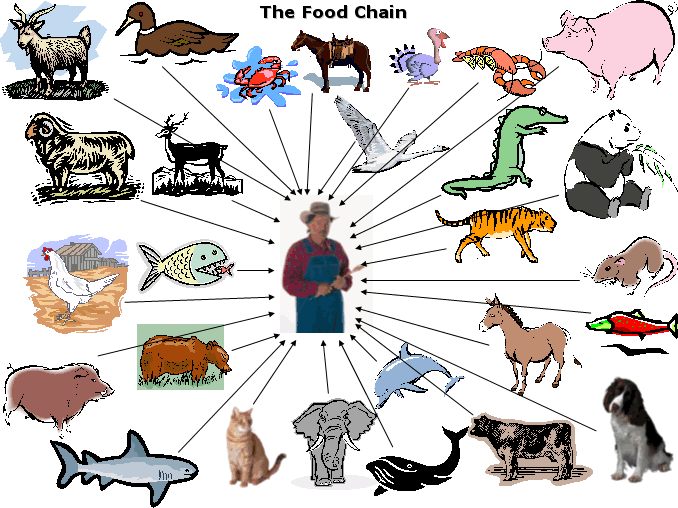
After reading that, I thought it was natural for me not to show concern for animal humanities. After all, we have ourselves to worry about. [1]

But George Orwell’s trial with the elephant struck a deeper chord: he mentioned the subject of my P1—individualism. In describing his situation, Orwell noted that he had no desire to kill the elephant that had caused havoc, only that he had to appease the crowd of 2000 that amassed around him: “The people expected it of me and I had got to do it; I could feel their two thousand wills pressing me forward, irresistibly.”[X221] This sentence immediately struck me as similar to one that I wrote in P3: “The “exposure” that I mention was not some sort of newfound physical contact with “people of color,” but rather a compression of my immediate needs and ideologies under the force of tens of thousands of new and different people on this campus. This is not to say my passion of individuality has collapsed, but I no longer assume that my ideas and viewpoints are right.” While it is not spot on, in that section I talk about the protection of an individual and not letting outside influences affect me too greatly. But George Orwell did. Mentioning how he had to conform to the natives’ wishes, “He wears a mask, and his face grows to fit it.”[X221] Orwell’s plight was that the crowd following him found it the natural process of things that the elephant get shot—much like my thoughts after reading turner that it is natural for man to be above animals, despite what “cruelties” he might see. But it is here that I realize that this assumption is conformity and thus an action that stifles what I once declared to be my greatest passion—individuality. The British imperialism forced Orwell to stick to the stereotype, to play the role of what he felt he was expected to and not what he wanted to.

Punk rock or not, conforming is good—only when you want it to happen.[2]

And so, I am left once again at intersection I have found so familiar this year: not knowing what to think. But, what is this? Poetry gives me an answer, an absolute, an ultimatum. Looking up at the vulture in orbit of his self, Robinson Jeffers convinces me that I will never hunt: “But how beautiful he looked, gliding down on those great sails; how beautiful he looked, veering away in the sea-light over the precipice. I tell you solemnly that I was sorry to have disappointed him. To be eaten by that beak and become a part of him, to share those wings and those eyes—what a sublime end of one’s body.”[X216] The destruction of beauty like that will never strike me as a sport—no matter how natural it seems.

[1]http://www.raw-tcsd.com/status%20quo263.jpg
[2]http://blog.chrisworfolk.com/wp-content/uploads/2006/10/foodchain.gif
[3]http://www.forrightorwrong.net/Shirt%20Pics/conformity-zoom.jpg