More than a band: a state of equilibrium. [1]

On the one hand, in James Turner’s Reckoning the Beast, I am convinced that it is the natural way of things for man to be above beast. I do not intend this to sound cruel. In describing the treatment of animals in preindustrial England, Turner writes that, “these bloodied animals were probably not victims of cruelty. Cruelty implies a desire to inflict pain.”[X170C] I then contrast this with the words of Reverend Dr. Humphrey Primatt, “We may pretend to what religion we please; but Cruelty is atheism. We may make our boast of Christianity; but Cruelty is infidelity. We may trust to our orthodoxy; but cruelty is the worst of heresies.”[X170G] Turner mentions this quotation because Primatt was the foremost authority on the advancement of animal humanities in 18th century western thought. However, Turner first wrote that the animals were not “victims” of cruelty because the men who committed those acts did not know any better. It is ironic, then, to defend mankind in light of ignorance when he indeed is supposed to be the rational one, but I think our collective empathy has indeed blossomed only once scientific discoveries concerning the similarities between men an animals were made. Perhaps Reverend Dr. Primatt was making a fuss over nothing, overstating the assumption that maltreatment of animals is necessarily “cruelty.” But the most provocative quotation from this chapter was Turner’s description of this supposed lack of empathy: “No generalized humanitarianism evoked fellow feeling with the suffereings of the next village, much less the plight of total strangers fifty miles away. People who walked hand-in-hand with plague, famine, and dying children could ill afford to squander their affective capital on useless emotion.”[X170C] Presently, we do not face the same “plague and famine” of that time, but the latter statement rings the bell of priority. Genocide and AIDS in Africa, a collapsing economy in the US, interminable uneasiness regarding extremists in the Middle East, among other global problems beg the question of whether animal humanities deserves so much attention. Even once scientific discovery lead to the knowledge that man and beast did not differ so much, Turner mentions that, “It did animals little good to be recognized as distant cousins if man would not lift a hand to help closer relatives.”[X170D]. I have long been a proponent of the phrase “Listen to your heart.” And ultimately, you cannot forge a passion for animal humanities unless you have it in you. That is, no matter what you think is wrong or right, something within you must drive a passion to fix things, and in my case, I do not know that I possess it.
After reading that, I thought it was natural for me not to show concern for animal humanities. After all, we have ourselves to worry about. [1]
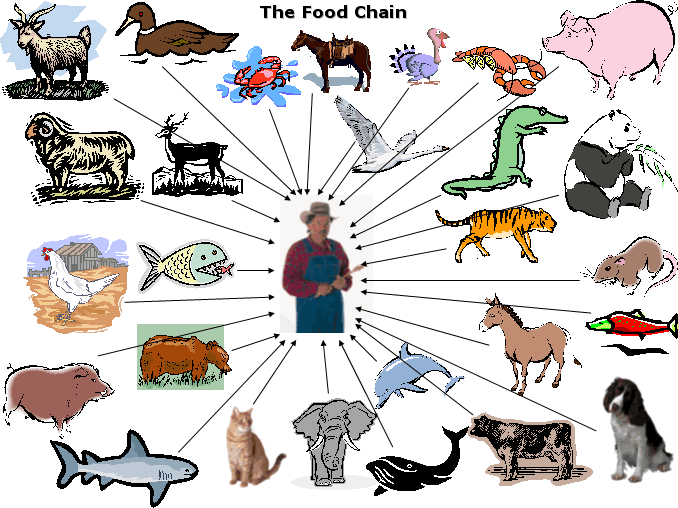
But George Orwell’s trial with the elephant struck a deeper chord: he mentioned the subject of my P1—individualism. In describing his situation, Orwell noted that he had no desire to kill the elephant that had caused havoc, only that he had to appease the crowd of 2000 that amassed around him: “The people expected it of me and I had got to do it; I could feel their two thousand wills pressing me forward, irresistibly.”[X221] This sentence immediately struck me as similar to one that I wrote in P3: “The “exposure” that I mention was not some sort of newfound physical contact with “people of color,” but rather a compression of my immediate needs and ideologies under the force of tens of thousands of new and different people on this campus. This is not to say my passion of individuality has collapsed, but I no longer assume that my ideas and viewpoints are right.” While it is not spot on, in that section I talk about the protection of an individual and not letting outside influences affect me too greatly. But George Orwell did. Mentioning how he had to conform to the natives’ wishes, “He wears a mask, and his face grows to fit it.”[X221] Orwell’s plight was that the crowd following him found it the natural process of things that the elephant get shot—much like my thoughts after reading turner that it is natural for man to be above animals, despite what “cruelties” he might see. But it is here that I realize that this assumption is conformity and thus an action that stifles what I once declared to be my greatest passion—individuality. The British imperialism forced Orwell to stick to the stereotype, to play the role of what he felt he was expected to and not what he wanted to.
Punk rock or not, conforming is good—only when you want it to happen.[2]

And so, I am left once again at intersection I have found so familiar this year: not knowing what to think. But, what is this? Poetry gives me an answer, an absolute, an ultimatum. Looking up at the vulture in orbit of his self, Robinson Jeffers convinces me that I will never hunt: “But how beautiful he looked, gliding down on those great sails; how beautiful he looked, veering away in the sea-light over the precipice. I tell you solemnly that I was sorry to have disappointed him. To be eaten by that beak and become a part of him, to share those wings and those eyes—what a sublime end of one’s body.”[X216] The destruction of beauty like that will never strike me as a sport—no matter how natural it seems.
[1]http://www.raw-tcsd.com/status%20quo263.jpg
[2]http://blog.chrisworfolk.com/wp-content/uploads/2006/10/foodchain.gif
[3]http://www.forrightorwrong.net/Shirt%20Pics/conformity-zoom.jpg

No comments:
Post a Comment