Jack Johnson asks the questions that I have begun asking myself because of this class: "Why are we here? And where do we go? And how come it's so hard?"[1]
Last week, we discussed what I desperately wanted to boil down to the interminable struggle of ignorance versus enlightenment. It is a favorite topic of mine--one that I have written many papers about. Specifically, I want to reference the maxim, "It is better to have loved and lost than never to have loved at all." I think that is how it traditionally goes, but I remember it with a slight syntactical change and a difference of end punctuation: "Is it better to have loved and lost or never to have loved at all?"
The sport of rowing reflects the benefits of an absolute ignorance:
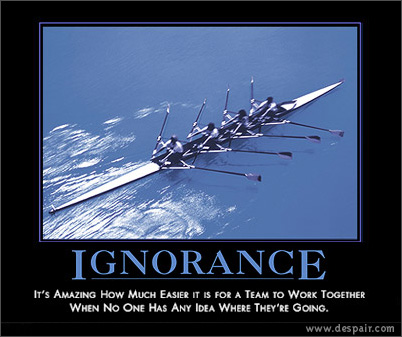
I have written several papers on the subject throughout my high school English career, and my conclusions remain immutable. Either absolute enlightenment or absolute ignorance is ideal, but mankind possesses the capacity for neither.
Life as a rock: always with a smile
 So, then, it seems as though I approach the subject of compassion versus survival of the fittest with a rather cynical paradigm. But, given that I am human and thus strewn into the agonizing pathos of our yearningly compassionate nature, I try my best to find that middle ground, flying in between the extremes in a way that Icarus could not.
It is no wonder why Ovid's works are indeed epic:
his messages are eternal
his messages are eternal

I would like to disagree with Dana and echo Saumya: it takes both compassion and self-interest to succeed. My proof--my high school class.
We wore white-tuxes instead of gowns.
Yeah, it is pretentious, but I will always be indebted to those who sat with me.
Yeah, it is pretentious, but I will always be indebted to those who sat with me.
 75 other boys walked across the stage with me last May. Exactly one third of those are attending Ivy League schools, a second third to similarly selective schools: Duke, Stanford, Northwestern, Notre Dame, and Georgetown. We had 23 National Merit Scholars. I am absolutely NOT trying to brag by saying "Oh yeah, well my high school was smarter than yours!" I do think that those statistics say something about the learning environment that exists at that school, but they also reflect the pomp and pretention that is rife within its walls. For the sake of discussion, please only focus on the former.
Anyway, my point is that there is a reason that some parents are willing to fork out exorbitant amounts of money for private school education (I, for one, think I would have thrived more in a public school setting, but I cannot deny the positive impact of the private sector). The reason: we 75 learned together. No one was left behind because of competition. Sometimes, groups of fifteen to twenty of us would collaborate on a single lab report, math problem, or reading assignment. We learned from great teachers, but we learned infinitely more from each other. I would not have made as high a grade in sophomore year Modern World History if not for my best academic friend Dhruv. More than that, I would not be the writer that I am without him, as I perpetually strive to mimick his trancedent eloquence. It is because of that environment that private schools are often excellent alternatives to public ones. We all looked out for each other, and those who witheld information, opinions, or insights were shunned. While we were all self-motivated and independent hard-workers, compassion fostered the harmony of our collective intelligence.
I feel as though Jude comes close to this ideal: "My God, how selfish I was! Perhaps--perhaps I spoilt one of the highest and purest loves that ever existed between man and woman!"[2] Jude takes it too far though. He focuses far too much on the idea of selflessness that he forgets to look out for himself. His obsession with Sue is impossible, and I refuse to believe that Hardy wants us to think that intrinsically, Jude does not realize this. And so, Jude's struggle is one of excessive compassion, or compassion in the wrong form, at least. Sue sits too far on the other side of the fulcrum: "Remember that the best and greatest among mankind are those who do themselves no worldly good. Every successful man is more or less a selfish man. The devoted fail...."[3] Indeed, successful men are selfish, but only to an extent. I am a man of absolutes, and I despise taking the middle ground. But the ultimate plight of the human condition requires that we do so.
[1] Johnson, Jack. "Better Together." In Between Dreams. 2005.
[2] Thomas Hardy, Jude the Obscure (New York: W.W. Norton & Company, 1999), 278
[3] Hardy, 284

No comments:
Post a Comment