 Much like the obliqueness of each line,
our sympathetic imagination will always be in limbo. [1]
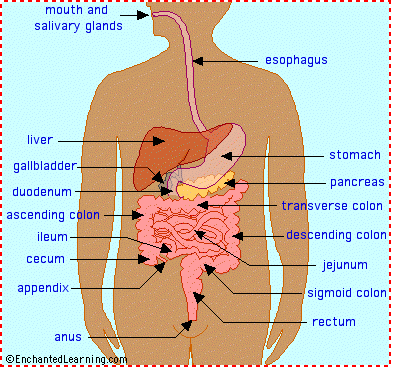 This was made for meat.[3]
Elizabeth Costello brings up the next important question, “Do we really understand the universe better than animals do?”[4]. I like to think that rarely has a cow ever contemplated its place in the world, but then again, this convoluted delicacy of the human mind may in fact be a plague more than anything else. As Costello further points out, she is “neither a god nor a beast.”[5] Before I begin to question an animal’s place in the world, I am going to have to start with myself, or, being no god, not pose the question at all.
Perhaps that is exactly why I, and all omnivores alike, continue to consume animals. Given the uncertainty and uneasiness of our own condition, why should the sympathetic imagination be extended to those whom we can’t even communicate with? Arising from this uncertainty is the defensive tactic of ignorance. “We avoid things that might disturb us” not because, in the case of animal rights, we support the torture and slaughter of animals, but because we already have enough to think about.[6] Even further, it is our nature to understand that we have to eat in order to survive, so there exists absolutely no intrinsic stigma to eliminate meat from our diets. Costello draws a parallel between meat-eating and the Holocaust stating that “ignorance may have been a useful survival mechanism, but that is an excuse which, with admirable moral rigour, we refuse to accept.”[7] I disagree with Costello here. In the pointless mass-murder of millions of people to satiate a soul-less dictator, ignorance does remain an unacceptable excuse. But to the billions of people, many of them starving, who need meat for sustenance, ignorance is something I won’t lose sleep over. As Costello’s son points out, her “opinions on animals, animal consciousness and ethical relations with animals are jejune and sentimental.”[8] At some point we have to draw the line of what we are responsible for. To the vast majority, the life of animals that can otherwise foster the survival of humans doesn’t make the cut.
 I would eat this steak. But probably not if I saw the cow that it came from.[9]
I’m going to assume that most animal rights activists are also pro-life.[10]
And finally, I come to compassion. But when it comes to animal rights, what compassion really exists? Let me introduce the doctrine of psychological egoism: it states that all humans act out of self-interest all the time. Altruism does not exist because it is merely a process that can make the performer of the altruistic act feel better about his or herself. Essentially, this is a pseudo-philosophy. It cannot be proven or disproven, as the proof and disproof of it is purely circular. But it begs intriguing questions. Doniger points out that, “Buddhists and Jains cared, like Elizabeth Costello, for individual human salvation, more, really, than they cared for animals.”[11] Further, Coetzee’s novel poses the question whether “vegetarians are really trying to save animals, or only trying to put themselves in a morally superior position to other humans.”[12] The doctrine does not apply just to vegetarians or animal rights activists. But it holds a stake in this debate. So, I ask all those who are vegetarians and/or support animal rights: do you do it because you truly feel compassionate and care for animals that you will never see, never connect with, never talk to? Or do you do it because it helps you sleep at night? I do not pose this question to degrade your stance or question your morality. I pose it because it is the reason why no one will ever convince me to stop eating meat.
[1] http://www.postaudio.co.uk/education/acoustics/room_images/oblique.png
[2]J.M. Coetzee, Elizabeth Costello (New York: Penguin Books, 2003), 76.
[3] http://www.enchantedlearning.com/subjects/anatomy/digestive/color.GIF
[4]J.M. Coatzee, Elizabeth Costello (New York: Penguin Books, 2003), 90.
[5] Ibid., 62
[6]Coetzee Introduction, X736.
[7]J.M. Coatzee, Elizabeth Costello (New York: Penguin Books, 2003), 62.
[8]J.M. Coatzee, Elizabeth Costello (New York: Penguin Books, 2003), 61.
[9]http://whatscookingamerica.net/Beef/BeefPhotos/TBoneSteak3.jpg
[10]http://www.asby.com.sg/image/EGG.jpg
[11]Wendy Doniger, “Reflections,” The Lives of Animals (Princeton: Princeton University Press, 1999), X749.
[12]Peter Singer, “Relfections,” The Lives of Animals (Princeton: Princeton University Press, 1999), X743.

No comments:
Post a Comment