We are all born into ignorance. Through the trials and tribulations of life, we hope to one day achieve understanding. It is the human condition.
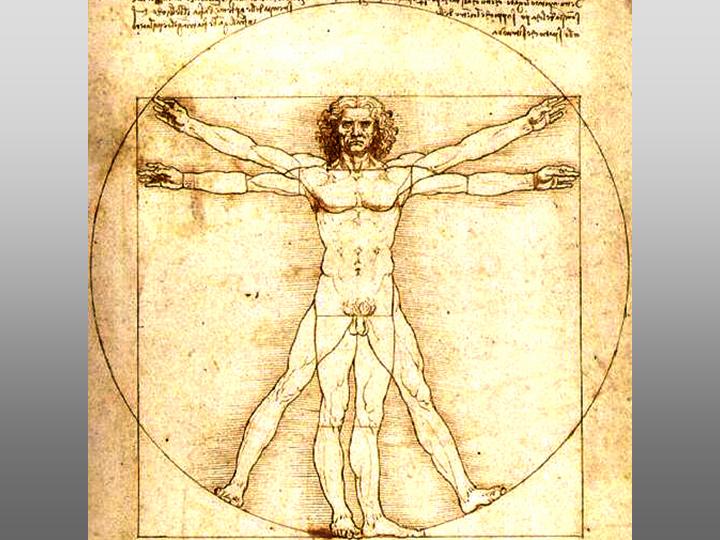
Nowhere does da Vinci draw anything pertaining to what is inside.
And so there isn't much heroism in conquering that ubiquitous shortcoming. It can effectively be summed up in what we call "growing up." But Alice does do something unique, something heroic. She does it on her own.
Those flowers certainly aren't human.
Perhaps I view it as heroism only because of that fact. Honestly, I am a very shy person. I hate approaching new things, and I hate approaching them a lone. But Alice not only chooses to venture down the rabbit hole, she not only stands up to but conquers the question when it is posed to her, "Who are you?"[1] Wonderland exists not only as an escape from the ordinary but also as a probe of her individual. When placed into the most foreign of lands, she forges her perspectives through experience a lone. As she tries to grab some sort of handle on who she is, "she crossed her hands on her lap, as if she were saying lessons, and began to repeat it, but her voice sounded hoarse and strange, and the words dd not come the same as they used to." [2] Having lost her sight of even herself, she dives deeper into the depths of Wonderland to find out more. Her methodology is venerable, as Sharon Begley points out that "If you make enough weak measurements, the average comes impressively close to the actual value."[3] Alice does indeed make plenty of "weak measurements" by her own hand. Out of them, she amasses an average out of the extraordinary, deriving from her own experiences a form of reason. Much like the Greek philosophers of Antiquity that I have written about before, she learns through her own experiences "as opposed to listening to someone else." [4] Much as was the passion I wrote about in P's 1 and 2, Alice creates her own individual in a land full of nothing but wonder. I don't know that I can call it inspiration or bravery, but I can view it as an example of accomplishment, of conquering the uncertain. Two goals that I believe everyone should strive for. I, for one, would not want to go down there. Perhaps it is everyones greatest fear: the unknown.
The topic of writers as heros then must come up if whom they create are to be viewed as such. Perhaps the word hero is too strong for a real world example, but the nomers role model and leader suit them perfectly. For the same reason that Alice is a hero, Carroll is a hero (a leader, at least). He created this vision of his through experience and shared it with us. His motivations and influences may be unbeknownst to us, but regardless, he crafts a lens through which we can see our own lives in the color of metaphor, guiding us with his insights and leading the way to higher understandings of that which surrounds us. Carroll, and all writers, paint for us visions of life that we not otherwise have, and for that, I look up to them. For I am no Alice, and I am afraid.
[1] Alice’s Adventures in Wonderland, Lewis Carroll, pg. 48 [2] Alice’s Adventures in Wonderland, Lewis Carroll, pg. 23 [3] "Putting Time in a (Leaky) Bottle" E603A Course Anthology, Sharon Begley, X690 [4] “How Alice Leads/Is a Hero”, E603ACourse Anthology, Amber Berclath, X692A
Monday, October 27, 2008
Jack Johnson asks the questions that I have begun asking myself because of this class: "Why are we here? And where do we go? And how come it's so hard?"[1]
Last week, we discussed what I desperately wanted to boil down to the interminable struggle of ignorance versus enlightenment. It is a favorite topic of mine--one that I have written many papers about. Specifically, I want to reference the maxim, "It is better to have loved and lost than never to have loved at all." I think that is how it traditionally goes, but I remember it with a slight syntactical change and a difference of end punctuation: "Is it better to have loved and lost or never to have loved at all?"
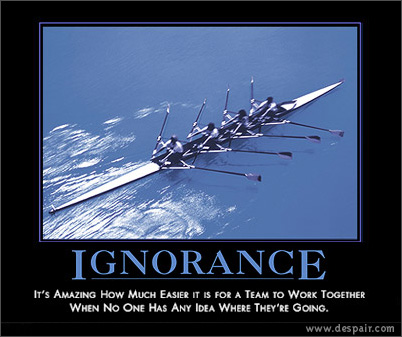
The sport of rowing reflects the benefits of an absolute ignorance:
I have written several papers on the subject throughout my high school English career, and my conclusions remain immutable. Either absolute enlightenment or absolute ignorance is ideal, but mankind possesses the capacity for neither.
Life as a rock: always with a smile
So, then, it seems as though I approach the subject of compassion versus survival of the fittest with a rather cynical paradigm. But, given that I am human and thus strewn into the agonizing pathos of our yearningly compassionate nature, I try my best to find that middle ground, flying in between the extremes in a way that Icarus could not.
It is no wonder why Ovid's works are indeed epic: his messages are eternal
I would like to disagree with Dana and echo Saumya: it takes both compassion and self-interest to succeed. My proof--my high school class.
We wore white-tuxes instead of gowns. Yeah, it is pretentious, but I will always be indebted to those who sat with me.
75 other boys walked across the stage with me last May. Exactly one third of those are attending Ivy League schools, a second third to similarly selective schools: Duke, Stanford, Northwestern, Notre Dame, and Georgetown. We had 23 National Merit Scholars. I am absolutely NOT trying to brag by saying "Oh yeah, well my high school was smarter than yours!" I do think that those statistics say something about the learning environment that exists at that school, but they also reflect the pomp and pretention that is rife within its walls. For the sake of discussion, please only focus on the former.
Anyway, my point is that there is a reason that some parents are willing to fork out exorbitant amounts of money for private school education (I, for one, think I would have thrived more in a public school setting, but I cannot deny the positive impact of the private sector). The reason: we 75 learned together. No one was left behind because of competition. Sometimes, groups of fifteen to twenty of us would collaborate on a single lab report, math problem, or reading assignment. We learned from great teachers, but we learned infinitely more from each other. I would not have made as high a grade in sophomore year Modern World History if not for my best academic friend Dhruv. More than that, I would not be the writer that I am without him, as I perpetually strive to mimick his trancedent eloquence. It is because of that environment that private schools are often excellent alternatives to public ones. We all looked out for each other, and those who witheld information, opinions, or insights were shunned. While we were all self-motivated and independent hard-workers, compassion fostered the harmony of our collective intelligence.
I feel as though Jude comes close to this ideal: "My God, how selfish I was! Perhaps--perhaps I spoilt one of the highest and purest loves that ever existed between man and woman!"[2] Jude takes it too far though. He focuses far too much on the idea of selflessness that he forgets to look out for himself. His obsession with Sue is impossible, and I refuse to believe that Hardy wants us to think that intrinsically, Jude does not realize this. And so, Jude's struggle is one of excessive compassion, or compassion in the wrong form, at least. Sue sits too far on the other side of the fulcrum: "Remember that the best and greatest among mankind are those who do themselves no worldly good. Every successful man is more or less a selfish man. The devoted fail...."[3] Indeed, successful men are selfish, but only to an extent. I am a man of absolutes, and I despise taking the middle ground. But the ultimate plight of the human condition requires that we do so.
[1] Johnson, Jack. "Better Together." In Between Dreams. 2005.
[2] Thomas Hardy, Jude the Obscure (New York: W.W. Norton & Company, 1999), 278
I am the typical teenager. I have received a baseline high school education and have enough experience to take care of myself. I pretty much have it all figured out. Right, Mom?
I could've smoked a pack a day!
It obviously doesn't quite work that way. But if there's one thing that I had figured out, it was what my high school counselors would refer to as "The College Process." I knew what I wanted. I didn't even visit schools. I went to Philadelphia once and checked out about eight different campuses while I was there, but that was a waste of time and money, albeit one my parents brought on themselves. You see, my brother is two years older than me and had already gone through the entire process. His objectivity and realism and borderline apathy carved out two years early the entire process for me. Along with my dad's sage advice (he is, in fact, the most down to earth being I have ever come across), I realized that in the end, it would not really matter where I go. "College is college," he would tell me. On that same note, he fully supported what I ever wanted to do, but I did not ever find a reason to put much stock into more than those three words. I wanted “the perfect place for contemplation” as well as a “protective environment within which to indulge” and nothing more (X638). I knew I could fulfill those ideals at almost any university in the country, so to be honest, I focused almost exclusively on three things: reputation, cost, and the attractiveness of the female contingency. In my mind, those were the only three criteria that I could use to discern one college from another. I was mailed at least six trees worth of literature in the form of college brochures, and they all said the same thing and had the same picture of a black, female political science major on the first page. Much like Jude Fawley, I "was an earnest and studious youth who is inspired by the example of the village school-teacher to set his heart on a place at Christminster” (X638). I could find an education anywhere, so why make that big of a deal out of it?
Well, she isn't exactly black, and this is a postgraduate brochure. But that's the point: its dumb.
In the end I wasted a lot of time applying to way too many schools. I earned a spot on seven waitlists, was rejected at four schools, and accepted into three. So I didn't have the most successful application process, but I didn't care. I had finally heard back from the last of those schools on March 31 at exactly 4:00 p.m., and my deposit at UT was paid by 4:15.
Maybe I got lucky. Maybe its just that Plan II is that much cooler than advertised. Maybe I'm intrinsically miserable and that acid I dropped on my way down here was some good shit...oh wait... I don't do drugs... But I am happy here, and as far as I can tell, I am quite a bit happier than all of my friends at different universities. In a Jude-esque manner, I didn't quite have much success in the college process. For the minutes that existed between 4:00 and 4:o5 on that fateful last day in March, the year of our Lord two-thousand and eight, I sulked "with the awful sense" that I had "wholly disgraced" myself (Hardy 15). But that feeling of impotence, un-accomplishment, and disappointment was brief. In an anti-Jude-esque manner, I did have much success in the college process. I ended up here. Fuck Notre Dame, and I didn't even apply.
The Pixies chant in the background, “With your feet on the air and your head on the ground….” The first building explodes, “…Try this trick, and spin it, yeah….” With a bellow like thunder, a second tumbles. “…Your head will collapse, but there’s nothing in it….” The remaining buildings quiver with the inanimate fear imposed on them by the viewer. “…And you’ll ask yourself, where is my mind?” Guitar riffs wail as the camera pans out, and Edward Norton’s nameless character clasps the hand of his new love, creating for himself the sublime ending to his forged conquest of the mundane. Like the buildings he watches crumble, he razes mediocrity in realization of the importance of identity. His mind, for the first time, drops anchor, creating his self between his ears, in perfect harmony with the apocalypse he harbors.
Norton's pilgrimage is that of meaning and identity.
The purpose of fight club is, as Tyler Durden puts it, because “We have no Great War. No Great Depression. Our Great War’s a spiritual war. Our Great Depression is our lives.” Edward Norton’s internal struggle stems from his lack of substance, his perpetuation of mediocrity, and obsessive materialism. He creates Tyler Durden as a representation of his ideals, and begins fight club to constantly combat the demons that he faces in realizing his failure as an individual. His victory over his idealism shows his maturation as a person and his defining of character. Edward Norton does not find himself in Fight Club; he creates himself. When faced with nothing spectacular, nothing but the pedestrian devils of the proletariat, he spawns greatness.
But what is the greatness that I see in it? I wrote about my passion for individuality in my previous project, and Edward Norton represents the consummate example of one who rejects the societal standard. With a feral indifference to those who govern him (i.e., his boss), he seeks out and achieves the creation of his individual. For this reason, Edward Norton is one of the few fictional characters that I will ever view as a hero. He suffers from no crippling memories of his past and has no physical obstacle that he must overcome—his plight is humanness. With no traumatic event or divine inspiration in his life to point him in a direction of purpose or pursuit of a passion, he undergoes the most powerful of metamorphoses and one that I view as the perfect manifestation of the purposes and core values of this literature course. I feel like I have experienced little trauma or revelation in the same way that Edward Norton had, and thus I view so much of life through the lens of soccer, as the sport had so much of an affect on my perspective on life, outside of kicking a ball around.
I have played on four different teams since I was ten years old, and from my differing experiences on all of them, I amassed my insights and perspectives. The greatest of which derived from the different personalities of each coach. From 7th to 9th grade, I played for a team called the Dallas Comets. We were a nationally ranked team, consistently competitive in the largest scale tournaments, in large part due to our coach. His name was Horst Bertl. His resume inspired awe—a former member of the German national team and several teams in the Bundesliga, Germany’s elite professional soccer league. His voice was hoarse, his accent as thick as his beard. His swollen belly protruded from under his shirt, as his passion for soccer was matched only by a fondness of beer. During games and practices, praise played sidekick to the villain of Horst’s spiteful yelling. Negative feedback existed as my sole motivator, and I did not thrive in that setting. I live for the pat on the back, and Horst reserved those for only the truly remarkable. And so, I played in constant fear. I possessed not a modicum of confidence in myself because, as it seemed, neither did Horst. My play style became passive: I shied away from the ball because I was terrified of losing it. Having the ball at my feet, I could see Horst—I could feel him—sitting in his blind, cross-hairs lined up perfectly over my cowering face, ready to murder what little faith I had left in myself. I no longer played to my strengths, and I slowly became the vision that Horst laid out for me: a one-trick role-player who was put on the field not to screw up. After my freshman year of high school, I had to change teams. I no longer played soccer for myself—I was playing to satisfy Horst.
He was indeed a good coach, just not for me.
Entering into my sophomore year, I was playing for two new coaches: my high school coach Cory and my new club’s coach Jason. Neither promised the same expertise that Horst did, but they proffered something far more valuable—confidence in my abilities as a player. Instantly, they transformed me. They offered no new instruction or insight to the game, but I could once again play. The summer between my 9th and 10th grade years purged me like a sauna. A ravenous bloodthirst for the ball at my feet characterized my new playing style. I was still prone to the same mistakes, but Jason and Cory would offer a pick-me-up: “Shake it off! Get your head in the game,” and I could. Because of their belief in me, I could once again play the game the only way I knew—as myself. My individuality was back, and thus my passion was back. I chased down opponents with a reckless disposition, I demanded the ball at my feet, and much as my long, red hair would denote, flowing and crackling chaotically as I played, the fire was back.
Coaches like Cory and Jason are heroes to me. They instilled their leadership vision in their teams and believed in their players. Because of that leadership, they allowed me to fulfill my greatest passion: they let me be myself on the field. It is funny, then, to analyze how I acted off the field. Under Horst, I was the quiet member of the team who hardly ever talked and followed. Under Cory and Jason, I became the team loud-mouth, constantly cracking jokes and conversing with my teammates, but most importantly, I lead. As the formation of my character continues, I see now the importance of Cory and Jason’s impact on me. My role as a leader is growing, and their visions have become mine. Robert J. Lee writes, “Your leadership vision must fit with your personal vision; it emerges from it and helps make your personal vision happen” (X79). My personal vision is to continually uphold my greatest passion—that of individuality and my unique self. Emerging from that now is my leadership vision: to inspire those around me in the same way that Jason and Cory inspired me. I can lead others by not doubting them—by believing in what they can do. My experiences through soccer have been emblazoned on my character in such a way that I believe I can pass this torch of leadership onto the next generation. This connection, between my passions of soccer and identity and their leadership vision, parallels Lee’s thoughts on the subject, “Within the larger story of your life, then, your view of yourself as a leader emerges” (X81). But it is not just the narrative of my career as a soccer player that directs my leadership vision. I would like to look back at Edward Norton’s character in Fight Club once again. He does not just create for himself an identity. He spreads his vision through the creation of fight club, providing an escape for the rest people suffering from the same injustices of mediocrity and boredom. His role as a leader is even further developed than Jason or Cory’s ever could be, as he fosters the chaotic sojourn from pedestrian to individual for thousands of other men. He does not simply believe in the men whom he fights, he shows them how to believe in themselves and to create themselves. That is the ultimate goal of my vision—to provide an avenue for others (although in a less extreme way) like Edward’s fight club. The interlocking gears of society are assembled by this paradigm—that six billion people, each with a voice, can grind in perfect harmony. My passion is indeed vague, but its leadership vision is explicit. When a community can grow together because of the distinct expression of each of its parts, and when a leader can inspire all to sing in their truest voices, greatness can be achieved.
My leadership vision does not extend only to extracurricular activities. Its relevance to the Plan II curriculum, and more specifically the role of this class, is striking. Perhaps the most unique aspect of the Plan II program is its conduciveness to academic freedom. But this freedom can only be beneficial if the professors of the broad range of required subjects can instill a sense of confidence in their students. Plan II is "education without boundaries," but without leaders who can inspire, boundaries can exist like an impermeable skull around the flowering mind. Particularly in this world literature course, compassion is a foundation of our learning, and compassion fosters a leader's ability to believe in his subjects. Without compassion, without leaders who can advance this vision, the freedom of the mind is stifled, and the purpose of this program is forgotten.
Monday, October 13, 2008
I have never actively attributed the title “hero” or “role model” to anyone. Unconsciously, heroes and role models have existed in my life, but their influences were passive, if not subtle. I am of the disposition that every instance, acquaintance, conversation, and relationship of my life has shaped me for the better or the worse in one way or another. When I had to write an essay about my hero for a 5th grade private school entry examination, I forced myself to write about Rusty Greer, the oft-sprawled, diving left-fielder for the then competitive Texas Rangers.
He saved many an out for the object of my youthful idolatry: The Texas Rangers
I could think of no one else whom I looked up to except for the red-headed, left-handed, butt-chinned, country-accented middle-of-the-lineup hitter. In all honesty, if not for the matching hair-color, I would have no reason to deem ol’ Rusty any more associable than the rest of the Rangers’ roster. And thus, my first conception of a hero spawned from the necessitation of words, any words, from an essay topic that rendered me taciturn. Devoid of profundity and lacking any notion other than overt superficiality, I clung to Rusty for the majority of my growing up.
The greatest hero of my high school: Ms. Sutcliffe
Now, at the experienced yet entirely sophomoric age of 18, I have an absolute definition of what a hero is to me, and one that will never change. My heroes are those who inspire me to be me. That is, after all, according to my P1, my greatest passion. But from my hero’s and role model’s perspective, it takes confidence and conviction to foster this passion. For that reason, I turn to Margaret Cousins, who nails what it is that we both believe, “In the heat and struggle and exhilaration of forging a life, I Found that their [my professor’s] names and faces, their words and precepts, their values and standards recurred to me consistently…more often than the names and faces of rosy girls with whom I had shared my hopes and dreams and sworn eternal friendship in presumably binding ceremonies” (X947). Ultimately, teachers, mentors, and professors are no more than catalysts. They cannot create, they can only inspire. What it is their job then, is to show the less obvious side of reality, to demonstrate what Robert Frost would call “the road less traveled.” I can tell you now who I will view as the most significant influences on me at this university—the professors. Some less than others, but they will all be my role models and my heroes. As Ms. Cousins writes, “Against formidable odds…they taught me how to think” (X947). That is what heroes do, above all elese. In my inevitably linked soccer career, I saw both sides of a positive and a negative role model. For three years I played for one of the top ranked teams in the nation. At the same time, I played for a coach that didn’t believe in me, and despite the competition I was facing, I was not rapidly declining as a player. So, after three miserable years with a bitter old man as a coach, I found a new team, and this happened to coincide with my first year on my high school’s soccer team. Both of my new teams’ had coaches that believed in me. I was playing at a slightly less competitive level, but I was playing better. This transition revived my career as a player as I was now achieving more of my potential. Eventually, my interest in the sport waned, but I came to a fuller understanding of what is my definition of a hero—one that inspires a belief in myself. Alan Bean would agree with me, “When I did begin to put out effort I did really well. That was a big eye-opener. Then I began to put out more effort and do more, and maybe that’s the story of my life, because now I realize that you can do what you want” (X977). It is the most tired maxim in the world, but it is so for a reason. Potential is a funny thing and broods the “what ifs” that defile and corrupt our hindsight as we view our current successes as a reflection of our past efforts. With heroes that believe in you, the question is never raised.