Wednesday, November 12, 2008

A central theme of this course is multimedia. We practice weekly to achieve smooth integration of verbal and visual rhetoric in order to convey a message more powerful than one without the other. Perhaps the most potent example of this was our viewing of Earthlings. I read the entire screenplay in the anthology without squirming or looking away from the text, but I can barely get through fifteen minutes of the film. I beheld the power of multimedia as my stomach churned and I focused at the bottom corner of the projector trying to ignore the gruesome images on the screen, unable to look away entirely. The reason for this is “’The artistic representation of history,’ Aristotle said, ‘is a more serious pursuit than the exact writing of history, for the art of letters goes to the heart of things.’”[1] When I think of Dobie’s mustangs, I think of my times in the wilderness when I have observed animals in their natural habitat. In my backyard even, I have been entranced by the behavior of ants, squirrels, and owls. There is indeed something about the artistic representation of nature that cannot be read in a text or even watched in a movie. In their natural state, animals are beautiful.


If there is one animal I wish I could see in its natural state, it would be the lion.[2]

Sometimes, I idolize animals. Certain animals, at least, while the knowledge of what is in Earthlings lurks in the back of my mind. They seem so blissfully ignorant, so unaware of the problems in life, yet so passionate and alive at the same time. My dog Jacie is a perfect example.

She is always ready to play.


What makes them beautiful is what makes them natural. Animals don’t worry about news, technological advances, or college. They worry about what is for dinner and when they can reproduce. What a life. Man, though deemed superior by himself, is so troubled, “the rule is simple: the more machinery man gets, the more machined he is.”[3] The advancement of mankind is at a snail’s pace, yet we are entirely concerned with what might be regarded as trivial in the great scheme of things. The more “machined” we get, the less natural we are, and the less beauty there is in our life. On that same note, it can be argued that this is our normal state—to contemplate trivially the goings on of the universe. But that is another argument.

So it becomes that what is natural is beautiful. Dobie’s mustangs remind me of a scene in American Beauty.


[4]

Although the plastic bag is far from an organism, it is beautiful because it is absolutely natural: “Only the sense of being in place gives natural horse or natural man contentment.”[5] Imagine being that bag, that sense of being in place, not caring where you are going, and breathing in the electricity of the air. Had I an ultimate goal, it would be to be like that bag, somehow. But I am human, and it is not that easy.


[1]850
[2]http://www.youtube.com/watch?v=_BtMuSjnGcY
[3]844
[4]http://www.youtube.com/watch?v=O3OhrWr5lzk
[5]843

Wednesday, November 5, 2008

A Compassionate Carnivore?

As I force myself to confront internally the morality, rationality, and reason behind my consumption of meat and other animal products, I find that the greatest chasm in my mind to cross over is the bridge of the sympathetic imagination. I find it hard enough to extend to other humans. Each of us has a unique past, an original paradigm, and individual constructions. Accounting for the universality of these constructs is the parallelism our nature and the standardization of our creation and genetic makeup. Yet even in this parallelism we can do no better than assume that these constructs are not oblique—we can never really know another.

Much like the obliqueness of each line,
our sympathetic imagination will always be in limbo. [1]

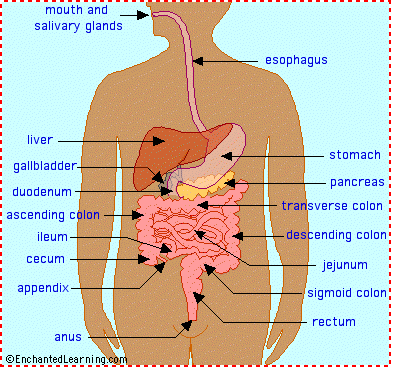
And so, the extension of the sympathetic imagination to those beings we deem animalistic is a much more difficult task. Indeed, “our minds are not bats’ minds.”[2] I do not quote this in order to argue our intellectual superiority to animals. Ironically though, and to the dismay of any animal rights activist, we are, quite literally, above the animals on the food chain. Considering our rather modest physical stature in comparison to some of the earth’s mightiest beasts, most will attribute our position to intellect. Regardless of what stance you want to take, the fact remains: we are meant to eat meat.

This was made for meat.[3]

Elizabeth Costello brings up the next important question, “Do we really understand the universe better than animals do?”[4]. I like to think that rarely has a cow ever contemplated its place in the world, but then again, this convoluted delicacy of the human mind may in fact be a plague more than anything else. As Costello further points out, she is “neither a god nor a beast.”[5] Before I begin to question an animal’s place in the world, I am going to have to start with myself, or, being no god, not pose the question at all.


Perhaps that is exactly why I, and all omnivores alike, continue to consume animals. Given the uncertainty and uneasiness of our own condition, why should the sympathetic imagination be extended to those whom we can’t even communicate with? Arising from this uncertainty is the defensive tactic of ignorance. “We avoid things that might disturb us” not because, in the case of animal rights, we support the torture and slaughter of animals, but because we already have enough to think about.[6] Even further, it is our nature to understand that we have to eat in order to survive, so there exists absolutely no intrinsic stigma to eliminate meat from our diets. Costello draws a parallel between meat-eating and the Holocaust stating that “ignorance may have been a useful survival mechanism, but that is an excuse which, with admirable moral rigour, we refuse to accept.”[7] I disagree with Costello here. In the pointless mass-murder of millions of people to satiate a soul-less dictator, ignorance does remain an unacceptable excuse. But to the billions of people, many of them starving, who need meat for sustenance, ignorance is something I won’t lose sleep over. As Costello’s son points out, her “opinions on animals, animal consciousness and ethical relations with animals are jejune and sentimental.”[8] At some point we have to draw the line of what we are responsible for. To the vast majority, the life of animals that can otherwise foster the survival of humans doesn’t make the cut.

I would eat this steak. But probably not if I saw the cow that it came from.[9]

I have raised chickens before, gathered their eggs, and had them for breakfast. I did this on a weekly basis for an entire year when I was in 4th grade. Never once did I flinch at this process. As an impressionable, blossoming 9 year old, I stole unborn babies from their mothers without a second though of it. Was I a heartless killer? No, I was acting naturally to procure food and turn a profit for my labors. There was nothing wrong with what I did.

I’m going to assume that most animal rights activists are also pro-life.[10]

And finally, I come to compassion. But when it comes to animal rights, what compassion really exists? Let me introduce the doctrine of psychological egoism: it states that all humans act out of self-interest all the time. Altruism does not exist because it is merely a process that can make the performer of the altruistic act feel better about his or herself. Essentially, this is a pseudo-philosophy. It cannot be proven or disproven, as the proof and disproof of it is purely circular. But it begs intriguing questions. Doniger points out that, “Buddhists and Jains cared, like Elizabeth Costello, for individual human salvation, more, really, than they cared for animals.”[11] Further, Coetzee’s novel poses the question whether “vegetarians are really trying to save animals, or only trying to put themselves in a morally superior position to other humans.”[12] The doctrine does not apply just to vegetarians or animal rights activists. But it holds a stake in this debate. So, I ask all those who are vegetarians and/or support animal rights: do you do it because you truly feel compassionate and care for animals that you will never see, never connect with, never talk to? Or do you do it because it helps you sleep at night? I do not pose this question to degrade your stance or question your morality. I pose it because it is the reason why no one will ever convince me to stop eating meat.


[1] http://www.postaudio.co.uk/education/acoustics/room_images/oblique.png

[2]J.M. Coetzee, Elizabeth Costello (New York: Penguin Books, 2003), 76.

[3] http://www.enchantedlearning.com/subjects/anatomy/digestive/color.GIF

[4]J.M. Coatzee, Elizabeth Costello (New York: Penguin Books, 2003), 90.

[5] Ibid., 62

[6]Coetzee Introduction, X736.

[7]J.M. Coatzee, Elizabeth Costello (New York: Penguin Books, 2003), 62.

[8]J.M. Coatzee, Elizabeth Costello (New York: Penguin Books, 2003), 61.

[9]http://whatscookingamerica.net/Beef/BeefPhotos/TBoneSteak3.jpg

[10]http://www.asby.com.sg/image/EGG.jpg

[11]Wendy Doniger, “Reflections,” The Lives of Animals (Princeton: Princeton University Press, 1999), X749.

[12]Peter Singer, “Relfections,” The Lives of Animals (Princeton: Princeton University Press, 1999), X743.

A Compassionate Carnivore?

Monday, November 3, 2008

Lesson Plan 11/4

Topics: Animal rights, extending the sympathetic imagination to animals


Main conflict: the cruelty of eating meat, regardless of how it was slaughtered.


Jenny: “It all comes down to pain and suffering…Pain and suffering are in themselves bad and should be prevented or minimized, irrespective of the race, sex, or species of the being that suffers.” (X729) My basic belief is this: no one (animal or human) should have to suffer at the hands of another.

Isn’t it our duty to give up a few luxuries, to become less selfish, in order to prolong all of the precious lives on this earth?
-why is it? do we have obligations to other species? perhaps to curb abuse but also to go so far as to eliminating a very natural part of our diet? not a rhetorical question, a topic to be debated

Samantha: While I would like to say that this movie instantly transformed me into a PETA activist and adamant vegetarian after seeing the gruesome processes by which our eating animals are slaughtered, I just love meat too much.
- is this not a contradiction and one that all meat-eaters must live with?


Ben:
One of the main problems that I had with the script was the argument about how “if we had to kill our own meat, we would all be vegetarian”[2]. If we all were forced to amputate our own legs, would there be no doctors, and everyone would then die? If we all had to manufacture auto parts, would there be no cars?

Also stating that we are all entitled to our own choices.

Skaggs:
I don’t mean to dismiss the idea of an alternative solution entirely, but my line of reasoning hits too many dead ends, and I can’t think of a practical and manageable solution myself.
-in the end we have to concern ourselves primarily with the advancement of our own species.

But no matter what you do, an animal that is to be slaughtered will suffer. I will not simply give up eating meat because other animals are suffering.
-the rub of ecosystems. should we start PETP (p for plants)? of course not.


Austyn: we have things to work on among our own species before we worry about animals.
Earthlings as propaganda.


Tyler:
I don’t think business owners particularly enjoy the fact that they inhumanely kill animals, but they certainly have no problem turning a blind eye if it nets them a greater profit.
-the epitome of human self-interest. how many of you are absolutely willing to go against this?


Pets as slaves?
-not sure how most feel about that....


Russell: "Even through sympathetic imagination, humans will never be able to fully understand a chicken's wants and needs."
-Russell should fight Dana.

Dana: Humans are undeniably animals
-but animals eat other animals.

Lydia would agree with Dana.


How ignorant are we really?

Skaggs, Ben, and Jenny seem aware.
-does ignorance and/or tolerance of abuses in slaughterhouses make a difference when it comes to eating meat, regardless of how the animal was treated?


Sympathetic imagination to pets: Jenny, Ben, Brian
-is it any more than the time we have spent growing up with them that makes us compassionate? Are there deeper connections? Other than those animals which we domesticate, should we have obligations to feel the same compassion for all animals?


Animals in Alice:

Jenny and Sammy both cite the lessons we have to learn from them.
-is it legitimate to use such an inane tale to advance our dependence on animals?
I will always be an omnivore. Nothing is going to change that. But I squirm at the fact that, according to Shaun Monson, I am ignorant. Meat tastes really good, and I am aware of the general abuse that occurs in slaughterhouses. But I would never directly hurt an animal. To an animal rights activist, I just contradicted myself. To the overwhelming majority of the human population, I have said nothing wrong. Perhaps, “Ignorance is the speciesist’s first line of defense.”[1] That “ignorance” is testament to the power of such a state of mind. I am conscious of what goes on, and I agree with the statement that “Killing an animal is, in itself, a troubling act.”[2] My circular reasoning currently leads me to believe I am either in denial of my ignorance or disbelief at my lack of compassion.
My cat Pepper. We, in fact, adopted her as a stray because we knew she needed a home.

Assume for a second that it was a common American practice to eat cat. I would never touch one. After growing up for the past ten years with Pepper, I have formed a bond. But I could never make that some connection with another animal (i.e., a cow) without the elongated juxtaposition I have undergone with Pepper. In his book The Outermost House, Henry Beston writes, “We need another and a wiser and perhaps a more mystical concept of animals.”[3] In order to curb the abuses, this is indeed what needs to happen. But the only way to achieve such would be to force all meat-eaters to grow up as cattle-ranchers. As long as we are human, though, we have other responsibilities. Activists may refer to those as trivial, but I object that those activists have absolutely no business telling me what is trivial and what is not. It is up to each individual to decide for his or herself what matters most, to prioritize a list a conveniences and then choose what he or she wants to believe in. Monson argues that “We must learn empathy, we must learn to see into the eyes of an animal and feel that their life has value because they are alive.”[4] Monson’s ideal is nearly impossible to achieve on a massive scale. Without communication, it is simply not going to happen. And, in fact, we cannot communicate fluently with animals, no matter what some left-wing, nature lover will tell us.
[5]
No matter how much time I might spend around an animal, trying to “bond” with it, I will never reach a mutual sense of communication. That is indeed the rub.

People will always exist above animals. Our genetic capabilities afford us this, and so it is hard to attribute the same rights to animals that humans deserve. Donald McNeil points out that the conflict exists in “how much kinship humans feel for which animals, and just which ‘human rights’ each human deserves.”[6] At some point, the idea of “animal rights” becomes silly. Apes driving cars? That should not even be taken seriously enough to be written about. Perhaps it boils down to conceit.

In Alice, there is a key difference: those animals could talk. After seeing a talking, hurried, white rabbit, “it occurred to [Alice] that she ought to have wondered at this”[7]. I might wonder, too, should I befriend a cow, whether or not I should order steak next time.

[1]“Earthlings”, E603A Course Anthology, Shaun Monson, X729
[2]“Earthlings”, E603A Course Anthology, Shaun Monson, X707
[3]“Earthlings”, E603A Course Anthology, Shaun Monson, X703
[4]“Earthlings”, E603A Course Anthology, Shaun Monson, X706
[5]http://www.insidesocal.com/greenspirited/cow2.jpg
[6]"When Human Rights Extend to Nonhumans", E603A Course Anthology, Donald G. Mcneil Jr., X732
[7]Alice’s Adventures in Wonderland, Lewis Carroll, pg. 12